
Operating intelligence for manufacturers
The truth about your operation, around the clock.
An analyst, a data scientist and a project manager that never go home. VERUS watches your ERP, maintenance, HR and CRM data all day, every day, finds what’s going wrong and where the money is, and keeps the fixes on track.
Good morning! Here’s what I found.
VERUS found
- ScrapWork center HB03: $24,421 in scrap in March, against a usual $10,705.
- On timeFour customers below 85% on time last week. One at 33%.
- CustomerThe largest customer: no call, visit or email in 107 days.
On the demonstration group, before anyone asked a question.
Read-only
It cannot change your systems.
The details +Less −
Inside your network
Your data stays on your machine.
The details +Less −
AI optional
Turn it off and it all still runs.
The details +Less −
Shows its work
Every number says where it came from.
The details +Less −
What it does
Three jobs, done all day, every day
It does the reporting your people build by hand today, and points at the processes that need fixing. No new system to feed.
The analyst
Does the daily reporting, so nobody has to build it.
The details +Less −
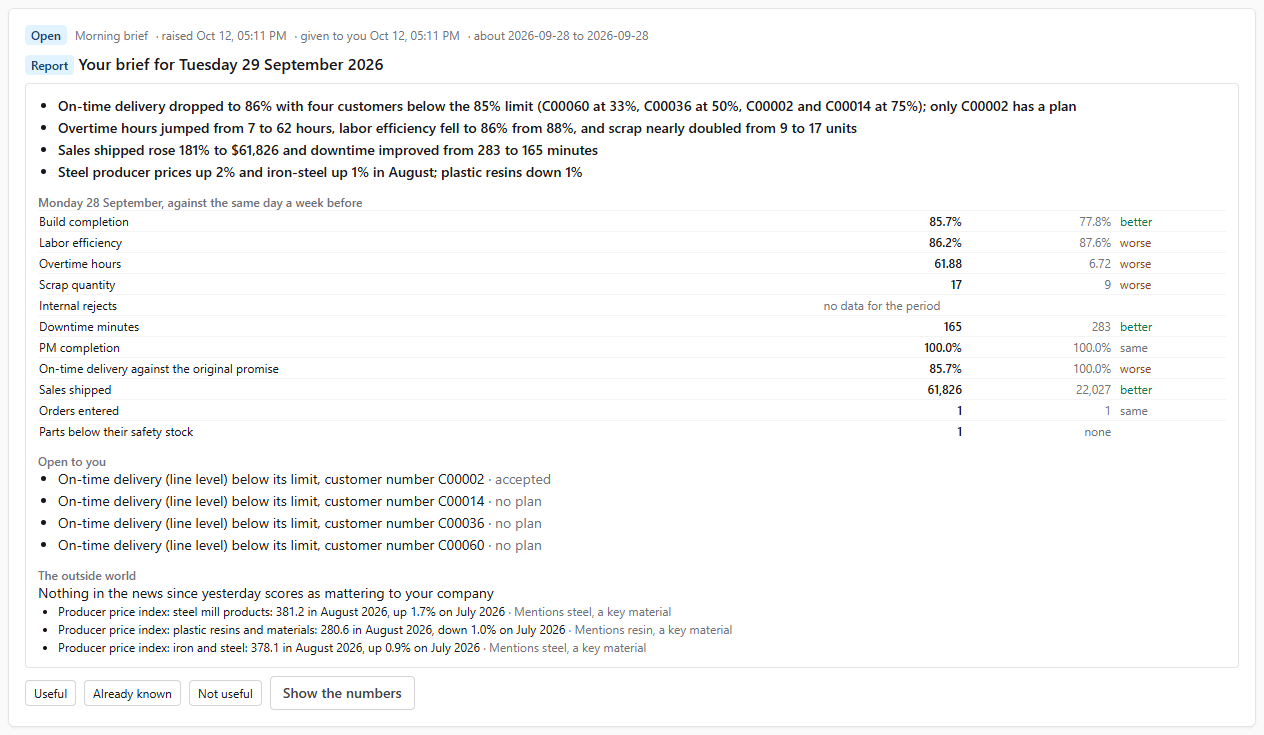
- Yesterday's numbers by line and department, against the same day last week, on one page every morning.
- Dashboards for each job: the plant manager's plant, the owner's companies side by side.
- Plain answers to questions, with the number, how it was calculated and how current the data is.
- Your own documents searched too: the quality manual answers, with the page it came from.
The data scientist
Watches everything, all day and all night, for what has changed.
The details +Less −
- Every line, machine, customer and supplier watched for spikes, slow drifts and early warnings.
- Before a watch is switched on, it is tested against the past year, so you see what it would have caught.
- Need to dig deeper? Build your own agent in one sentence, run it once or on a schedule, and share it with your team.
- Bad data called out: catch-all reason codes, promise dates changed after shipping.
- Findings ranked by what they cost in dollars where that can be measured, with outside prices such as steel and resin brought in where they touch your costs.
The project manager
Keeps the fixes on track until they are done.
The details +Less −
- A finding becomes a plan with steps, owners and due dates.
- The plan carries the measure it will be judged by, taken when the plan is accepted.
- On the review date it measures again and says whether the plan worked.
- Open plans show up in the morning brief until they are closed.
What it catches
Found before anyone asked a question
On the demonstration group: two manufacturers, three years of records. Two of these are problems in the data itself, which sit under every report built on it. VERUS calls those out first.
$24,421
in scrap at one work center in March, against a usual $10,705
33%
on time for one customer last week; four customers were below 85%
107 days
since anyone called, visited or emailed the largest customer at one company
1,252
order lines whose promise date was moved to the ship date after shipping, so on time looked better than it was
50%
of all downtime booked to one catch-all reason code, so the breakdown by reason means little
1 month
raised in a year by the scrap-against-steel agent: the one the market didn't explain
See it
Two minutes inside the real product
Told by VERUS himself: a plant manager’s morning, an agent described in one sentence, and the owner’s view.
Take a closer look. These are the real screens.
Yesterday, what crossed a line, and the plans under way, on one page before the first meeting.
Less work, not more
Manage by exception, not by meeting
Only what crossed a line
VERUS watches every number all day and brings you only what crossed a line: a spike, a slip, a big customer gone quiet. Everything else needs no meeting to review.
No data project
It reads the systems you already have, where they are. Nothing to move, nothing new to feed, no data entry.
It finds the broken processes
Promise dates changed after shipping, a catch-all reason code, one shift coding scrap its own way. Fix the process, not the report.
The outside world, every morning
Prices for your key materials, industrial production, energy, rates and the trade news that names your materials, customers or competitors. It separates what the market did from what you did.
The details +Less −
Setting it up
Up and running without a data project
I work out the rest myself. I only ask what I can’t.
- 1
Connect
Give it the address and a read-only login. ERP, MES, maintenance, quality, warehouse, HR, CRM, your data warehouse, spreadsheets: if it has a database, an API or exports files, VERUS can read it.
- 2
It maps itself
It works out your tables and codes, and already knows how many common products store their records.
- 3
A few yes-or-no questions
Where it isn't sure, it asks your people. A maintenance system took five.
- 4
It keeps itself current
Installed on one machine in about six minutes. Fast-changing records pulled through the day, the rest overnight.
Who it’s for
Built for the people who run the plants and own them
Plant managers
Their plant only. Yesterday's numbers, the problems that need a decision, and the plans under way, without waiting on an analyst.
Operations leadership
Every plant on the same definitions, straight from the systems, with a warning wherever the data can't be trusted.
Owners and boards
Every company side by side, read from the systems rather than from a monthly pack, with problems flagged the week they start.
Where it stands
VERUS is built, and ready for its first companies. It runs today on a demonstration group: two manufacturers, one in the United States with two plants and one in Canada, with three years of ERP records and HR, CRM and maintenance systems alongside. Several companies in one installation work today. One view across companies that each run their own installation is next, built with the first group that needs it. Every result we have measured is on the evidence page.